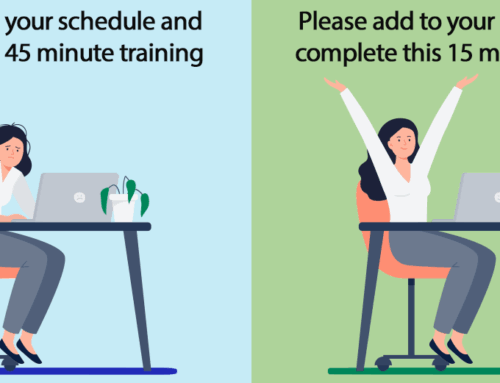

98% Completion Does Not Mean 98% Compliance
The 98% didn’t stop them.
- Completion measures exposure.
- Compliance depends on recognition under pressure.
Most compliance failures do not result from an employee “missing” a policy; they result from a failure to recognize the policy’s relevance in a high-pressure moment.
The Shift to Scenario-Based Compliance Training
While annual training establishes baseline awareness, many organizations are discovering that completion metrics alone don’t translate into confident decision-making. This is where scenario-based compliance training becomes the critical link.
Unlike traditional methods that focus on policy exposure, scenario-based training places employees in realistic workplace situations, challenging them to identify risks in real-time. By practicing decisions in a safe environment, employees bridge the “Recognition Gap”—the distance between knowing a rule exists and knowing when it applies to the conversation they are having right now.
The Recognition Gap: 3 Real-World Scenarios
Why Knowledge Does Not Always Translate Into Action
Even when employees complete compliance training and understand company policies, real-world decisions often occur in situations that feel routine rather than risky. Employees may not recognize that they are entering a compliance-sensitive moment until after the decision has already been made.
The following examples illustrate common situations where knowledge gaps, memory decay, or contextual pressure can create uncertainty.
Scenario 1: The “Small” Signature Adjustment
- The Situation: A regional sales leader is closing a major contract at quarter-end. The customer requests that the effective date be set to the prior week to align with their internal budget approvals.
- The Employee’s Thought: “The deal was verbally agreed to last week. We’re just aligning the paperwork to help a partner.”
- The Risk: Backdating agreements creates accounting and disclosure issues. Because the conversation felt operational rather than ethical, the “compliance alarm” never went off.
Scenario 2: The Relationship That Feels Personal
- The Situation: A procurement manager has worked with the same supplier for years. During a review, the supplier mentions that the manager’s cousin was recently hired into their leadership team.
- The Employee’s Thought: “I’ve always been fair. This doesn’t change my objectivity, so there’s no need to make a fuss.”
- The Risk: Conflict-of-interest policies require disclosure regardless of perceived “fairness.” Because the situation felt personal rather than regulatory, transparency broke down.
Scenario 3: The Informal Data Share
- The Situation: A product manager receives a request from a trusted business partner for preliminary customer data to “help prepare a joint proposal.” The data isn’t fully anonymized, but the partner is a long-term ally.
- The Employee’s Thought: “We’re on the same team. This helps both companies, and it’s not like we’re publishing it to the public.”
- The Risk: Strict data protection policies. In high-pressure environments, sharing feels collaborative, not risky. Recognition fails under the pressure to be a “team player.”
The Evolving Standard: Does Compliance Training Actually Work?
Compliance training plays a vital role in communicating corporate expectations and documenting policy awareness. However, the industry is seeing a shift in how “success” is defined. While high completion rates satisfy administrative requirements, they do not always translate into confident decision-making in real-world situations.
The challenge is that awareness has a shelf life. Employees may understand a policy during an annual session but struggle to recognize its relevance months later when it is buried under the pressure of a project deadline or a complex vendor relationship.
The encouraging news is that many organizations are strengthening their programs by adding reinforcement strategies throughout the year. Rather than replacing annual training, these approaches extend its impact by helping employees practice recognizing the specific “risk moments” where compliance decisions actually occur.
How it Works: Defining Scenario-Based Compliance Training
If the goal is behavioral assurance, the methodology must change. Scenario-based compliance training moves beyond the “passive lecture” by placing employees in realistic, high-fidelity workplace situations and asking them to decide on an appropriate course of action.
Instead of simply reading a policy, employees must evaluate a “gray area” narrative, consider the possible responses, and receive immediate feedback aligned with company values. These short, focused simulations mirror the types of situations we’ve just explored:
-
Evaluating a vendor’s gift during a high-stakes contract renewal.
-
Responding to a request for a “small” document adjustment at quarter-end.
-
Managing the casual sharing of confidential information in a collaborative setting.
When used as periodic reinforcement throughout the year, these short decision moments help employees recognize risk situations more quickly and respond appropriately. By practicing these decisions in a safe, simulated environment, employees strengthen their “recognition reflex.” This ensures that when the situation happens for real, they don’t just remember the training—they recognize the risk.
Why Recognition Fails
Even the most well-intentioned employees fail to identify risk for predictable reasons:
- Normalization: “This is just how deals get done in our industry.”
- Relational Trust: “I know these people; they aren’t trying to trick me.”
- Incentive Alignment: “This move helps the team hit the quarterly goal.”
- Familiarity: “We’ve handled it this way five times before without an issue.”
From Exposure to Behavioral Assurance
Do employees recognize risks?
Do they apply policies in practice?
- Scenario-Based Reinforcement: Move away from “Yes/No” policy questions and toward complex, “gray-area” narratives.
- Contextual Prompts: Use short, frequent decision prompts that mirror the real-world pressures employees face.
- Spaced Learning: Revisit high-risk topics in short intervals throughout the year rather than in one annual “dump.”
- Focus on the “Pause”: Train employees to recognize the physical or mental cues of a risk moment so they know when to stop and consult a policy.
The Bottom Line: Completion demonstrates coverage; Recognition protects the organization.
- Completion metrics demonstrate coverage.
- Scenario-based reinforcement strengthens recognition.
- Recognition protects the organization when real-world pressure arises.