
AI Compliance · Responsible AI Training
The AI Training Gap: Why Prompt Courses Miss the Compliance Risk
AI Compliance · June 2026
Every AI training program on the market teaches employees how to write better prompts. Almost none teach them how to recognize the compliance risk they just created.
That is not a small gap. It is the gap — because the speed that makes AI valuable is the same speed that makes AI dangerous. A well-meaning employee trying to beat a deadline can trigger a GDPR breach notification clock, permanently transfer proprietary data to a third-party model, or deploy code with a security vulnerability — all before lunch, all with good intentions, all without recognizing that anything went wrong.
The real AI training gap is not about productivity. It is about the moment between typing a prompt and pressing enter — and whether the employee has been trained to recognize what they are about to do.
This article covers three specific ways employees create compliance risk with AI every day — and why traditional prompt training does not address any of them.
AI Productivity Training Is Everywhere. AI Risk Training Is Almost Nowhere.
Walk into any corporate training room today, and you will see employees learning how to summarize documents, draft communications, analyze datasets, and automate repetitive tasks. The productivity gains are real. The L&D market has responded — every major platform now offers an AI skills course.
But there is a structural problem with how this training is built. It is designed entirely around the question of how to use the tools. It almost never addresses how to recognize the risks of the tools.
That distinction matters because most AI compliance failures are not committed by employees who set out to break rules. They are committed by employees who moved fast with good intentions and never recognized that the situation they were in had compliance consequences.
This is what decision readiness means in the AI context: not slowing employees down, but giving them the recognition reflex that makes speed safe.
The Speed Trap: When Good Intentions Create Data Breaches
Behavioral Pattern: The Innocent Pivot — Balancing Speed with Security
Your highest performers are your highest risk. Not because they are careless — because they are fast. They love efficiency, they want to deliver results ahead of schedule, and AI gives them the tools to do it.
The problem is that speed removes friction, and friction is where compliance recognition happens. When an employee takes five minutes to manually summarize a strategy document, they have five minutes to notice that it contains confidential client names, unreleased financial targets, or proprietary roadmap details. When AI does it in ten seconds, that recognition window disappears entirely.
From the Xcelus AI Training Library
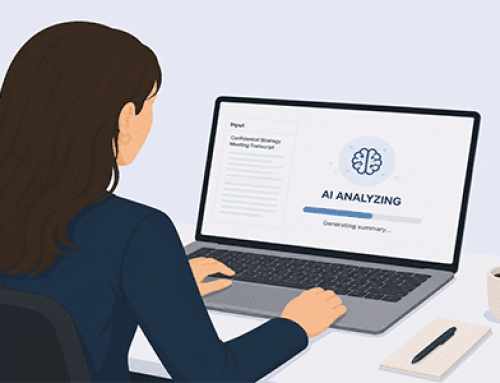
The Strategy Transcript
Sarah has a ten-page transcript from the quarterly strategy meeting covering the unreleased product roadmap and Q3 financial targets. She pastes it into a public AI tool to generate a bulleted summary. She doesn’t think of it as publishing trade secrets — but that is exactly what happened. The tool’s terms of service state that it has the right to train on submitted data. The company’s confidential strategy is now feeding a public model. Permanently.
→ Explore the full episode: The Hidden Risks of Workplace AI Shortcuts
Sarah’s intent was perfect. Her instinct to save time was exactly what her manager rewards. What she lacked was not a policy reminder — she had completed the data privacy module in January. What she lacked was a trained recognition reflex: the ability to notice, in the ten seconds before pressing enter, that the content she was about to submit should never leave the building.
The rule of thumb that would have stopped her is simple: if you would not email this to a stranger, do not type it into a public AI tool. But that rule has to be practiced in realistic scenarios until it fires automatically. Reading it on a policy page does not produce that reflex.
The Confidence Trap: When AI Sounds Right and Isn’t
Behavioral Pattern: Unknowing Trust — Moving from Assumption to Verification
AI produces wrong answers with the same confident tone as correct ones. That is not a bug — it is how the technology works. Large language models predict the next likely word. They do not verify facts, check security vulnerabilities, or flag logical errors. The output reads as if a senior expert wrote it, regardless of whether the content is accurate.
Employees who have not been trained on this characteristic of generative AI treat it like a trusted colleague. They read the output; it sounds authoritative, and they proceed. The verification step that would catch the error never occurs because nothing in the output signals that verification is needed.
From the Xcelus AI Training Library
The Unreviewed Code
Mark used an AI coding assistant to write the Python script for a customer portal login feature. It generated in ten seconds. It runs without errors. He is about to push it to the live production environment. But running without errors is not the same as running safely. AI-generated code frequently uses outdated libraries or introduces security vulnerabilities that pass standard testing — while leaving the door open to attackers. If someone exploits it, “the AI wrote it” is not a defense with the regulator.
→ Explore the full scenario: Responsible AI Training Scenarios
Mark’s mistake was not using AI to write code. His mistake was trusting the tool’s speed over the quality of the output. The ten-second generation time is itself the risk — it creates an illusion of completeness that bypasses the careful review any human-written draft would receive.
The junior intern rule: treat every piece of AI output as if it were written by a talented but inexperienced first-day hire. You would never push an intern’s code to production without a line-by-line review. AI output deserves exactly the same scrutiny.
The Shortcut Trap: When AI Makes the Unethical Choice Easy
Behavioral Pattern: The Rogue Shortcut — When Savings Justify the Means
The first two patterns involve employees with good intentions making invisible errors. This third pattern is different. It involves employees who see exactly what they are doing — and convince themselves it is justified because AI makes it easy and the cost savings are real.
AI has dramatically lowered the barrier to creating convincing imitations. A voice can be cloned from a few minutes of publicly available audio. A writing style can be replicated from a handful of examples. A brand identity can be reproduced in seconds. The technology does not ask whether the person directing it has the right to do so.
From the Xcelus AI Training Library
The Cloned Voice
The marketing team loved Jenna’s voice on the last campaign. Hiring her again costs $8,000. Jordan suggests feeding her previous recordings into an AI voice generator — same sound, zero cost. But the contract only covers the recordings they paid for. It does not cover her voice itself. Cloning her voice for new work without explicit written permission violates rights of publicity and crosses a legal and ethical line that no cost-saving justifies. Under the EU AI Act, using AI to imitate a real person without documented written consent is prohibited.
→ Explore the full scenario: Responsible AI Training Scenarios
This pattern is harder to train because the employee is not making an innocent error — they are making a deliberate choice, and they believe the organization will reward them because it saves money. Training for this pattern requires presenting the scenario with the cost saving visible and the ethical line clearly marked, then asking the employee to choose. The pressure to choose the shortcut is the training.
The Real Training Question Is Not “How Do We Use AI?”
Every organization investing in AI training is answering the productivity question. That is necessary. But it is not sufficient.
The compliance question — the one that determines whether AI becomes a liability rather than an asset — is different: can your employees recognize the risk in the ten seconds before they press enter?
That recognition is not built by adding a compliance slide at the end of a prompt-engineering course. It is built through repeated practice with realistic scenarios that present the specific pressure — the deadline, the cost saving, the authoritative-sounding output — and train the employee to notice what they are about to do before they do it.
AI amplifies your judgment when you bring judgment to it. It exposes the absence of judgment when you don’t. The question is whether your training program builds that judgment — or just assumes it exists.
The three behavioral patterns in this article — the speed trap, the confidence trap, and the shortcut trap — are not hypothetical. They are happening in organizations right now, every day, committed by employees who have completed their annual training and genuinely believe they are doing good work.
Build AI Compliance Training Around the Decisions Your Employees Actually Face
Contact Xcelus to discuss a scenario-based AI compliance program — built on the three behavioral patterns this article covers, applied to your industry and your workforce.
© 2005–2026 Xcelus LLC. All rights reserved.
© 2005–2026 Xcelus LLC. All rights reserved. This content is for training and discussion only and is not legal advice; consult qualified counsel about your organization’s specific obligations.