Responsible AI · Leadership & Governance
The $81,000 AI Bill Wasn’t the Real Problem. The Missing Guardrail Was.
When you tell everyone to “go use AI” and set no limits, the overspend isn’t a discipline problem. It’s a governance gap — and it belongs to leadership.
The Short Answer
Who is responsible when an employee runs up a huge AI bill?
Responsibility is shared, but the primary failure is usually structural, not personal. When leadership enables an uncapped AI tool and invites people to experiment freely — with no spend limit, no guidance, and no one watching usage — the missing guardrail is the real problem, and setting it is a leadership job. Blaming the employee who took the invitation literally fixes nothing and leaves the gap wide open.
In mid-2026, the fintech startup Slash made the rounds online after one of its employees ran up roughly $81,000 in AI coding credits in about a week — building, of all things, a meme-style shooter game with no obvious core business purpose. The company had publicly encouraged its people to lean into AI-assisted coding, and it took the whole thing in stride, joking that everyone should play the game so it could be written off as marketing. The internet did what the internet does: within days, the story was everywhere, and the takeaway almost everyone reached for was the easy one. What was that employee thinking?
It’s the wrong question. And the reason it’s the wrong question is the whole point — because the same setup that produced a funny $81,000 bill is sitting, right now, inside a lot of companies that told their people to “go use AI” and never said where the walls were.
The employee appears to have acted inside the broad invitation leadership created — experimenting freely with an uncapped tool. He may have misjudged how fast the costs would climb. But the organization built the conditions for that misjudgment to become an $81,000 problem. The guardrail was never set.
Why the Blame Reflex Misses the Real Failure
When a bill like this lands, the room’s immediate instinct is to hold the employee accountable. It feels responsible. It even feels like leadership. But it points at the wrong thing, for a simple reason — based on what’s public, the employee wasn’t breaking a rule, because there doesn’t appear to have been one. He was invited to experiment, handed an uncapped tool, and left alone with it. He walked through a door that leadership had left open.
Punishing him for that does two things, both bad. It penalizes someone for doing what they were told, which chills exactly the experimentation the company said it wanted. And it lets everyone in the room avoid the harder admission: the mandate to “go use AI” went out with no spend cap, no usage alert, no guidance on what was worth building, and no one assigned to watch. That’s not an employee failure. That’s a governance gap.
Why This Keeps Happening
The pressure that creates this gap doesn’t feel like negligence. It feels like ambition. Every organization is racing to adopt AI, and in that race, putting limits on it can feel like falling behind — or like walking back the very mandate leadership just issued. So the guardrail never gets set. It stays a “we’ll figure that out later” item until a bill arrives and forces the conversation nobody wanted to slow down for.
There’s a second reason, quieter but just as common: the risk is structurally invisible. “Who owns AI spend visibility?” is not a question on anyone’s agenda — not the CFO’s, not the CIO’s, not the CEO’s — because it sits in the gap between all of them. It belongs to no single seat, which is exactly why it stays open. In most incidents like this, the honest answer to “who owned the guardrail?” is: no one.
The Real Leadership Mistake: Permission Without Boundaries
The dangerous leadership move isn’t encouraging AI. It’s encouraging AI without defining what the permission includes. Does “go use AI” mean experiment with code? Use customer data? Upload internal documents? Connect tools to live systems? Spend company funds? Build side projects? When leadership doesn’t say, employees fill in the blanks themselves — reasonably, and in a dozen different directions at once.
That’s what makes this bigger than an AI-ethics question. It’s a finance-control issue, an IT-visibility issue, a data-protection issue, and a leadership-communication issue at the same time — which is precisely why it falls through the cracks. Every one of those owners assumes another one has it.
What Leadership Actually Does About It
The fix isn’t dramatic, which is part of why it gets skipped. Guardrails don’t kill innovation — they make it sustainable. A cap with an alert lets people experiment freely up to a known limit, instead of the company discovering the limit through a surprise bill. Concretely, that means:
A spend cap and a usage alert — per person or per team — so runaway usage trips a signal long before it trips a five-figure bill.
Simple guidance on what’s worth building — so “experiment freely” has an actual shape, not just an open door.
A named owner — cross-functional by design: engineering or IT for the technical cap, finance for the threshold, leadership for what “go use AI” authorizes.
Real-time visibility — so someone can answer the one question that matters at any moment: what are we spending right now?
The Bill Was the Cheap Version
Here’s the part that should keep leadership up at night — and it starts with an uncomfortable admission. That $81,000 arguably paid for itself. The incident went viral, put the company’s name in front of an audience a marketing budget couldn’t buy, and burnished exactly the fun, move-fast, AI-native image a startup wants. On paper, they came out ahead. And that is precisely what makes it a dangerous lesson.
Because the story that now spreads through every leadership team is “someone burned $81,000 and it turned into great marketing.” That’s the seductive, wrong lesson. The next company running the same uncapped-everything playbook doesn’t get to choose whether its uncontrolled-AI incident is a viral game or a data breach. The same missing guardrail — an uncapped tool, no boundaries, no owner, no visibility — that produced a shareable side project is the one that lets an employee paste proprietary code or customer data into a public model, or spin up unmonitored production spend. One version comes with a punchline. The other comes with a disclosure obligation.
The overspend just happened to be the version that came with a receipt — and a marketing halo. Treat it as a one-time win and you’ve learned the wrong thing. Treat it as the signal it is — that you’ve enabled a powerful capability across your organization without governing it — and you close the gap before the next incident lands on the wrong side of the coin.
Turn This Into a Conversation Your Team Actually Has
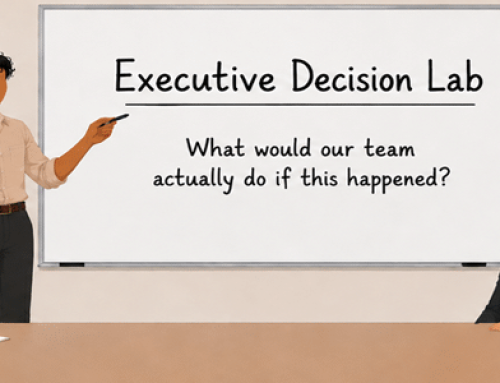
The reason this failure repeats is that most organizations never have the guardrail conversation until a bill forces it. Xcelus turns an emerging risk like this into a connected set of tools: a short scenario for employees, a Decision Brief™ a manager can run in 15 minutes, an Executive Decision Lab™ for the leadership team that owns the fix, and a Compliance Conversation that explains why it matters.
Read the scenario → · The Decision Brief™ → · The Executive Decision Lab™ →
Frequently Asked Questions
Who is responsible when an employee runs up a huge AI bill?
Responsibility is shared, but the primary failure is structural. When leadership enables an uncapped tool and invites free experimentation with no limit, guidance, or monitoring, the missing guardrail is the real problem — not the employee’s judgment. The durable fix belongs to whoever can set the rail, which is leadership.
How do you control AI spend without slowing down innovation?
Set a spend cap paired with a usage alert. It lets people experiment freely up to a known limit, so you keep the speed and lose the surprise bill. Guardrails make experimentation sustainable rather than blocking it — the alternative is discovering your limit after it’s already been crossed.
Who should own AI spend and usage guardrails?
It’s cross-functional: engineering or IT owns technical caps and alerts, finance owns budget thresholds and monitoring, and leadership owns what “go use AI” actually authorizes. The point isn’t the org chart — it’s that someone must own it. In most AI-spend incidents, no one did.
Where has your team said “go use AI” without a guardrail?
Have the governance conversation before a bill forces it. Xcelus turns emerging risks like this into leadership discussions your team can actually run.
© 2005–2026 Xcelus LLC. All rights reserved.
© 2005–2026 Xcelus LLC. All rights reserved. This content is for training and discussion only and is not legal advice; consult qualified counsel about your organization’s specific obligations.